Text
The UK coronavirus crisis – even more so in its second phase – is all about basic inequalities – and lockdown makes these worse
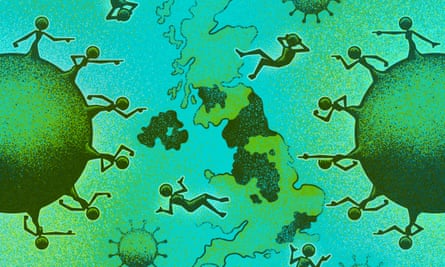
The pitched battle over lockdowns is missing the point: Covid-19 is a class issue
Last modified on Sun 18 Oct 2020 14.56 BST
Just as our final exit from the EU comes into view, noise from the media and politics about Covid-19 is sounding discomfortingly similar to the furies that erupted around the 2016 referendum.
On one side stands the political right, opposed to lockdown, apparently spurning the advice of experts, and seemingly convinced that a mixture of true-Brit common sense and derring-do will somehow see us through. The left, meanwhile, emphasises the importance of “the science”, and the prospect of disaster. As in the US, it is beginning to feel like any contentious political question will now trigger these polarised responses – not necessarily in the population at large, but certainly among the people whose opinions define what passes for the national conversation.
News coverage of the second wave has so far tended to focus on which places should go in which official tiers, the distinction between pubs and restaurants, and the decision to send students back to universities. What has not been discussed nearly as much is the plain fact that the coronavirus crisis – even more so in its second phase – is all about basic inequalities, and the kind of questions of work, housing and poverty that deep crises always bring to the surface. In other words, Covid-19 is a class issue. That may sound simplistic, but what it actually denotes is an intricate set of considerations that the argument over lockdown is not acknowledging.
Since the start of the crisis, I have been regularly talking to many of the leaders in the north of England whose anger at condescending treatment from Boris Johnson and his colleagues continues to make the headlines. As many of them see it, one reason for the recent increases in infection is that the initial lockdown affected many of their areas differently than more affluent places. Rather than retreating inside to bake their own bread and have work meetings on Zoom, people in such trades as construction, warehousing and care work had to carry on venturing outside and mixing with others in the first wave, so levels of the virus remained comparatively high, even before the summer reopening then took them back to dangerous levels. Clearly, the ability to render yourself housebound is also dependent on whether your domestic environment makes remaining at home either viable or all but impossible. The basic point was recently nailed by the Financial Times writer Anjana Ahuja: “This crisis has broadly separated us into the exposed poor and the shielded rich.”
Andy Burnham, the Greater Manchester mayor, recently told me about one correlation that highlights this disparity. He said that in a swathe of the country that takes in Greater Manchester, east Lancashire and West Yorkshire, Covid hotspots map on to areas that were the focus of the last Labour government’s so-called Pathfinder scheme: the programme that aimed to replace old housing by bringing in private developers, and left a legacy of unfinished work and huge resentment. “The quality of housing in those areas is still extremely poor,” said Burnham. “Lots of families live intergenerationally. It’s very overcrowded. How would you self-isolate in a situation like that?”
This is a good riposte to the oft-heard suggestion that most people who fail to follow the rules are degenerate “Covidiots”, and further proof that in a society as insecure as ours, trying to stringently control anything – let alone a highly infectious disease – will tend to be very difficult indeed. According to research done at King’s College London, only 18% of people self-isolate after developing symptoms, and only 11% quarantine after being told by the government’s test and trace system that they have been in contact with a confirmed case. Among the factors the study associates with non-compliance are “lower socio-economic grade”, and “greater hardship during the pandemic”. A lot of people, it seems, would like to do what they are told, but simply can’t.
This is the basic point the government does not seem to have grasped – painfully highlighted by Johnson’s claim that infections increased because the public became “complacent”. Threatening people with fines of up to £10,000 if they fail to self-isolate – and, we now learn, passing their details to the police – is an example of the same cast of mind, less likely to persuade people in precarious circumstances to follow the rules than to keep their distance from the authorities. The fact that some people on very low incomes are finally eligible for a lump sum of £500 to cover a fortnight’s quarantine will not solve what is obviously a massive problem; in terms of basic practicalities, it is of a piece with Rishi Sunak’s plan to pay only two-thirds of lost wages to people affected by local restrictions.
But before anyone on the left starts feeling too self-righteous, they also have questions to answer. There is a cold, dogmatic attitude in certain quarters that seems to define itself against anything that smells of Tory laissez-faire. Earlier in the year, it was manifested in rigid opposition to schools reopening, as some people averted their eyes from the inequalities the suspension of education was making worse. Now, some of the same voices stridently argue for strict national measures, as if that proposition is straightforward. It is actually not just complex, but full of potential contradictions. A prime example: given that poverty and precarity are what make millions of people vulnerable to both Covid infection and the life-threatening complications that can come with it, the hardship that any lockdown creates will make those problems even worse. This, surely, is the circuit that desperately needs to be broken, but after so many wasted years it will take a long time to do it.
In the meantime, a daily ritual of political futility goes on. Some people on the right yearn for a return to shrunken government, rugged individualism and the primacy of “the economy”, whatever that is. On the opposing side, people would like us to diligently follow the edicts of a reborn state, but social conditions are too far gone to allow many people to do anything of the kind. To those at the sharp end of this crisis, neither position will sound particularly convincing.
So it is that increasing numbers of people ignore the current political drama, and muddle through as best they can. Parallels with the vote to leave the EU are not only about the divisive arguments that have gripped the political class, but the fact that many of the same places whose experience fed into their vote for Brexit – Hartlepool, Preston, Oldham, Middlesbrough – are also suffering the worst of the pandemic. The inequality they embody remains the essence of the 21st-century British condition: four years on from 2016, this is still a country so imbalanced that it keeps falling over.
• John Harris is a Guardian columnist
© 2020 Guardian News & Media Limited or its affiliated companies. All rights reserved. (modern)
lessons from a pandemic
The coronavirus crisis should usher in an age of global co-operation, argues Jared Diamond, the Pulitzer Prize-winning geographer
Jared Diamond MAY 28 2020 www.ft.com

The Covid-19 pandemic represents a tragedy for its victims and their families, and economic hardship for the rest of us. As I write these lines in Los Angeles, 10 weeks after the state of California imposed a lockdown, some shops are reopening and a semblance of normal life is beginning to return.
But the costs have been great: in my case, the past month has brought the deaths of five friends, two of them among my longest relationships. Against that background, it seems vile to say anything “positive” about Covid-19. Paradoxically, though, the pandemic might also bring hope and permanent benefits for the whole world — depending on how we react.
Microbes have often shaped human history. Thousands of years before the Black Death, a previous spread of plague may have contributed to the intrusion of Asian steppe peoples carrying Indo-European languages into Europe. Later, far more Native Americans — including the Aztec emperor Cuitláhuac and the Inca emperor Huayna Capac — died in bed from European germs than on the battlefield from European swords and guns.
Those epidemics of the past had far-reaching harmful consequences: military defeats, population crashes, abandonments of land under cultivation and slumps in trade. They also resulted in conquests and replacements of populations, when previously unexposed peoples contracted diseases from invaders with a long history of exposure.
At the time of writing, official counts are approaching 350,000 deaths globally from Covid-19; the true figure is likely to be higher. Steep death tolls are still to come in populous countries such as Brazil and Mexico, aided by policies of denial on the part of those countries’ presidents.
Yet Covid-19 doesn’t represent an existential threat to the survival of our species. Yes, the pandemic will be a serious blow to the world’s economy, but that will recover; it’s only a matter of time. Unlike many of the epidemics of the past, the virus isn’t threatening to cause military defeats, population replacements or crashes, or abandonments of land under cultivation.

A new era? The pandemic offers the world a rare opportunity for an unprecedented level of co-operation © NurPhoto via Getty Images
There are other dangers, present right now, that do constitute existential threats capable of wiping out our species, or permanently damaging our economy and standard of living. But they are less convincing at motivating us than is Covid-19, because (with one exception) they don’t kill us visibly and quickly.
Strange as it may seem, the successful resolution of the pandemic crisis may motivate us to deal with those bigger issues that we have until now balked at confronting. If the pandemic does at last prepare us to deal with those existential threats, there may be a silver lining to the virus’s black cloud. Among the virus’s consequences, it could prove to be the biggest, the most lasting — and our great cause for hope.
What, really, are our existential threats? There are four that I consider to be the most serious.
They start with the threat that could kill the most people in the shortest time: the detonation of large numbers of nuclear weapons, whether launched as a pre-emptive strike (for example, between India and Pakistan), as the unintended consequence of escalating responses (say, between North Korea and the US), as the response to misread early-warning signals (as nearly happened repeatedly during the cold war) or as an intentional action by terrorists.
The nuclear threat may or may not materialise, but the other three threats already have — and are getting worse. They have the potential to cripple permanently our standard of living, though they would leave many of us still alive. Those threats are: climate change; unsustainable use of essential resources (especially forests, seafood, topsoil and fresh water); and the consequences of the enormous differences in standard of living between the world’s peoples, destabilising our globalised existence.
This is the context in which the virus could actually bring us a benefit. As a motivator, Covid-19 is different from, and more potent than, those existential problems. Covid’s symptoms are palpable; they are indubitably due to the virus; Covid’s consequence of death poses no problems of definition or measurement; and that consequence follows swiftly. None of this is true of climate change, though it will do far more lasting damage to us.

An Extinction Rebellion demonstration in New York last year © NurPhoto via Getty Images
But whether that motivational benefit of Covid-19 actually does emerge will depend on how the world responds to this truly global crisis. We can draw guidance from how nations respond to national crises. In my recent book Upheaval, I established a dozen outcome predictors that have made it more or less likely that a nation would respond successfully to a national crisis: among them were acknowledgment rather than denial of a crisis’s reality; acceptance of responsibility to take action; and honest self-appraisal.
For example, the outstanding success of 19th-century Japan in modernising began with the crisis provoked by the uninvited visit of Commodore Perry’s warships in 1853. Japan acknowledged its weakness; it took action by adopting a crash programme of selective changes; and it honestly appraised its military strength at every step of a cautious military expansion.
If the world joins to solve the crisis against heavy odds, our current pandemic might thus represent the beginning of a bright era of worldwide co-operation
Among other national outcome predictors, I judge as crucial the presence or absence of a shared national identity, which can help a nation’s people to recognise their shared self-interest and to unite in overcoming a crisis. National identities variously depend on different things for different nations, such as a shared language and culture, pride in a shared historical legacy and shared environment, or a shared common enemy.
That last factor has proved particularly potent in times of crisis. The Japanese attack on Pearl Harbor galvanised Americans literally overnight. It instantly created a shared determination to accept sacrifice, for however long it would take. For Finns, the galvanising experience was the Winter War of 1939-40, when they preserved their independence (albeit at the cost of enormous losses) by fighting to a standstill the invading armies of the Soviet Union, whose population was 40 times Finland’s. For Indonesians, fragmented among hundreds of islands, 726 languages and four major religions, unity coalesced around their shared independence struggle against the Dutch, and then around one shared national language.
For all three countries — the US, Finland and Indonesia — purposeful action followed an external threat. But global problems have never generated a comparable sense of urgency. Until the unprecedented danger posed by Covid-19, there has never been a struggle that united all peoples of the world against a widely acknowledged common enemy.
d society, writes Simon Schama. But, amid the horror there is hope
As a result, we have been hamstrung in our responses, especially to climate change. All four of those dangers threaten every one of the world’s peoples. Yet nations have been dealing with them, or have been avoiding dealing with them, one by one. Even before President Donald Trump pulled out of the Paris agreement on climate change, that deal fell far short of an effective solution to the problem. Nations haven’t joined in acknowledging that climate change will ruin every nation, that every nation is contributing to causing it (some nations more than other nations), that all nations must do their share in the struggle, and that the failure of even just one nation to do its share will harm all other nations.
The one-by-one approach is as impotent for solving the danger posed by Covid-19 as it is for solving the problem of climate change. Even if all countries save one should succeed in quelling their own virus outbreaks, that remaining country sustaining Covid-19 will serve as a permanent focus to reinfect the rest of the world. Covid-19 is at last providing us world citizens with a shared enemy, an unequivocal quick killer, a threat to the inhabitants of every nation.
There are precedents for our finding world solutions to world problems. The 1973 International Convention for the Prevention of Pollution from Ships (Marpol) led to regulation that reduced pollution of the world’s oceans by separating oil tanks from water tanks on ocean-going ships, and by mandating double-hulled tankers for all transport of oil by sea.
In 1980, the World Health Organization completed the worldwide eradication of smallpox, among the most devastating diseases in human history. The stratosphere’s ozone layer became protected by the Montreal Protocol of 1987, restricting worldwide the production and use of chlorofluorocarbons and other gases. The 1994 Law of the Sea Convention at last delineated exclusive national and shared international economic zones around the world.
All of those efforts resolved very difficult problems by means of high-level international agreements, even without a sense of world identity on the part of the public at large.
Thus, a best-case outcome of our current crisis would be for it to create, at last, a widespread sense of world identity: to make all peoples recognise that we now face the common enemy of global problems that can be solved only by a united global effort.

A rainbow appears over the Novomoskovsky medical centre, south of Moscow, for patients with suspected coronavirus infection © TASS
Covid-19 would then illustrate, at the world level, another outcome predictor of success in national crises and individual crises: the memory of a previous crisis that was overcome, creating confidence that a new crisis can also be overcome. When I first visited Finland in 1959, 19 years after the end of the Winter War, there was still a widespread consensus among Finns.
Nothing could have been more difficult, for Finland with its population then under 4m, than fighting off the enormous Soviet Union; but Finns nevertheless succeeded then, and so they expected to be able to overcome any new problem that Finland faces today.
Similarly, if the world joins to solve the current visible Covid-19 crisis against heavy odds, our current pandemic might thus represent the beginning, not of a dismal era of chronic worldwide danger, but of a bright era of worldwide co-operation. Hopeful signs already are the rapid recent development of co-operation among scientists studying the virus all around the world, and the shipments of supplies from China and Russia to the US to combat the American epidemic.
That’s the best-case scenario. The worst-case scenario would be if we instead continued our doomed attempts to solve the virus problem one country at a time, or even one American state at a time.
In that case, we’d also entrench our doomed attempts to solve other global problems one country at a time.
Which of these two opposite scenarios will the world choose? We’ll know the answer to that question by the end of this year.
Jared Diamond is the Pulitzer Prize-winning author of ‘Guns Germs and Steel’, ‘Upheaval’, and ‘Collapse’
Letter: Sino-US tensions have an ominous ring
From Ali Wyne, Non-resident Senior Fellow, Atlantic, Council, Washington DC, US
While recent months have furnished some evidence that the Covid-19 pandemic could inaugurate what Jared Diamond calls “a bright era of worldwide co-operation” (Life & Arts, May 27), perhaps most excitingly the collaboration of scientists from around the world to develop a vaccine, their principal effect has been to illuminate the dangers that uncircumscribed competition poses to a world that will increasingly be shaped by transnational challenges, notwithstanding widespread prophecies of deglobalisation.
Those dangers come into sharpest focus when considering the relationship between the US and China, which collectively account for some two-fifths of global output. It would have been regrettable had the gravest crisis thus far this century failed to distract them from their intensifying rivalry. That the pandemic has, in fact, brought ties between the world’s two preeminent powers to their lowest level since normalisation is ominous and alarming. It is hard to believe that it was only a little over a decade ago that they co-ordinated with one another and activated the G20 to ensure that a sharp macroeconomic downturn did not morph into another Great Depression.
Today, five months into a health-cum-economic emergency that is exacerbating humanitarian disasters, increasing food insecurity, and upending energy markets, middle powers must contend with a sobering possibility: that Washington and Beijing will prove either unable or unwilling to subordinate bilateral frictions to global imperatives.
Ali Wyne
Non-resident Senior Fellow, Atlantic Council
Washington, DC, US
the world after coronavirus
This storm will pass. But the choices we make now could change our lives for years to come

© Graziano Panfili
Humankind is now facing a global crisis. Perhaps the biggest crisis of our generation. The decisions people and governments take in the next few weeks will probably shape the world for years to come. They will shape not just our healthcare systems but also our economy, politics and culture. We must act quickly and decisively. We should also take into account the long-term consequences of our actions. When choosing between alternatives, we should ask ourselves not only how to overcome the immediate threat, but also what kind of world we will inhabit once the storm passes. Yes, the storm will pass, humankind will survive, most of us will still be alive — but we will inhabit a different world.
Many short-term emergency measures will become a fixture of life. That is the nature of emergencies. They fast-forward historical processes. Decisions that in normal times could take years of deliberation are passed in a matter of hours. Immature and even dangerous technologies are pressed into service, because the risks of doing nothing are bigger. Entire countries serve as guinea-pigs in large-scale social experiments. What happens when everybody works from home and communicates only at a distance? What happens when entire schools and universities go online? In normal times, governments, businesses and educational boards would never agree to conduct such experiments. But these aren’t normal times.
In this time of crisis, we face two particularly important choices. The first is between totalitarian surveillance and citizen empowerment. The second is between nationalist isolation and global solidarity.
Under-the-skin surveillance
In order to stop the epidemic, entire populations need to comply with certain guidelines. There are two main ways of achieving this. One method is for the government to monitor people, and punish those who break the rules. Today, for the first time in human history, technology makes it possible to monitor everyone all the time. Fifty years ago, the KGB couldn’t follow 240m Soviet citizens 24 hours a day, nor could the KGB hope to effectively process all the information gathered. The KGB relied on human agents and analysts, and it just couldn’t place a human agent to follow every citizen. But now governments can rely on ubiquitous sensors and powerful algorithms instead of flesh-and-blood spooks.

In their battle against the coronavirus epidemic several governments have already deployed the new surveillance tools. The most notable case is China. By closely monitoring people’s smartphones, making use of hundreds of millions of face-recognising cameras, and obliging people to check and report their body temperature and medical condition, the Chinese authorities can not only quickly identify suspected coronavirus carriers, but also track their movements and identify anyone they came into contact with. A range of mobile apps warn citizens about their proximity to infected patients.
About the photography
The images accompanying this article are taken from webcams overlooking the deserted streets of Italy, found and manipulated by Graziano Panfili, a photographer living under lockdown
This kind of technology is not limited to east Asia. Prime Minister Benjamin Netanyahu of Israel recently authorised the Israel Security Agency to deploy surveillance technology normally reserved for battling terrorists to track coronavirus patients. When the relevant parliamentary subcommittee refused to authorise the measure, Netanyahu rammed it through with an “emergency decree”.
You might argue that there is nothing new about all this. In recent years both governments and corporations have been using ever more sophisticated technologies to track, monitor and manipulate people. Yet if we are not careful, the epidemic might nevertheless mark an important watershed in the history of surveillance. Not only because it might normalise the deployment of mass surveillance tools in countries that have so far rejected them, but even more so because it signifies a dramatic transition from “over the skin” to “under the skin” surveillance.
Hitherto, when your finger touched the screen of your smartphone and clicked on a link, the government wanted to know what exactly your finger was clicking on. But with coronavirus, the focus of interest shifts. Now the government wants to know the temperature of your finger and the blood-pressure under its skin.
The emergency pudding
One of the problems we face in working out where we stand on surveillance is that none of us know exactly how we are being surveilled, and what the coming years might bring. Surveillance technology is developing at breakneck speed, and what seemed science-fiction 10 years ago is today old news. As a thought experiment, consider a hypothetical government that demands that every citizen wears a biometric bracelet that monitors body temperature and heart-rate 24 hours a day. The resulting data is hoarded and analysed by government algorithms. The algorithms will know that you are sick even before you know it, and they will also know where you have been, and who you have met. The chains of infection could be drastically shortened, and even cut altogether. Such a system could arguably stop the epidemic in its tracks within days. Sounds wonderful, right?
The downside is, of course, that this would give legitimacy to a terrifying new surveillance system. If you know, for example, that I clicked on a Fox News link rather than a CNN link, that can teach you something about my political views and perhaps even my personality. But if you can monitor what happens to my body temperature, blood pressure and heart-rate as I watch the video clip, you can learn what makes me laugh, what makes me cry, and what makes me really, really angry.
It is crucial to remember that anger, joy, boredom and love are biological phenomena just like fever and a cough. The same technology that identifies coughs could also identify laughs. If corporations and governments start harvesting our biometric data en masse, they can get to know us far better than we know ourselves, and they can then not just predict our feelings but also manipulate our feelings and sell us anything they want — be it a product or a politician. Biometric monitoring would make Cambridge Analytica’s data hacking tactics look like something from the Stone Age. Imagine North Korea in 2030, when every citizen has to wear a biometric bracelet 24 hours a day. If you listen to a speech by the Great Leader and the bracelet picks up the tell-tale signs of anger, you are done for.

You could, of course, make the case for biometric surveillance as a temporary measure taken during a state of emergency. It would go away once the emergency is over. But temporary measures have a nasty habit of outlasting emergencies, especially as there is always a new emergency lurking on the horizon. My home country of Israel, for example, declared a state of emergency during its 1948 War of Independence, which justified a range of temporary measures from press censorship and land confiscation to special regulations for making pudding (I kid you not). The War of Independence has long been won, but Israel never declared the emergency over, and has failed to abolish many of the “temporary” measures of 1948 (the emergency pudding decree was mercifully abolished in 2011).
Even when infections from coronavirus are down to zero, some data-hungry governments could argue they needed to keep the biometric surveillance systems in place because they fear a second wave of coronavirus, or because there is a new Ebola strain evolving in central Africa, or because . . . you get the idea. A big battle has been raging in recent years over our privacy. The coronavirus crisis could be the battle’s tipping point. For when people are given a choice between privacy and health, they will usually choose health.
The soap police
Asking people to choose between privacy and health is, in fact, the very root of the problem. Because this is a false choice. We can and should enjoy both privacy and health. We can choose to protect our health and stop the coronavirus epidemic not by instituting totalitarian surveillance regimes, but rather by empowering citizens. In recent weeks, some of the most successful efforts to contain the coronavirus epidemic were orchestrated by South Korea, Taiwan and Singapore. While these countries have made some use of tracking applications, they have relied far more on extensive testing, on honest reporting, and on the willing co-operation of a well-informed public.
Centralised monitoring and harsh punishments aren’t the only way to make people comply with beneficial guidelines. When people are told the scientific facts, and when people trust public authorities to tell them these facts, citizens can do the right thing even without a Big Brother watching over their shoulders. A self-motivated and well-informed population is usually far more powerful and effective than a policed, ignorant population.
Consider, for example, washing your hands with soap. This has been one of the greatest advances ever in human hygiene. This simple action saves millions of lives every year. While we take it for granted, it was only in the 19th century that scientists discovered the importance of washing hands with soap. Previously, even doctors and nurses proceeded from one surgical operation to the next without washing their hands. Today billions of people daily wash their hands, not because they are afraid of the soap police, but rather because they understand the facts. I wash my hands with soap because I have heard of viruses and bacteria, I understand that these tiny organisms cause diseases, and I know that soap can remove them.

But to achieve such a level of compliance and co-operation, you need trust. People need to trust science, to trust public authorities, and to trust the media. Over the past few years, irresponsible politicians have deliberately undermined trust in science, in public authorities and in the media. Now these same irresponsible politicians might be tempted to take the high road to authoritarianism, arguing that you just cannot trust the public to do the right thing.
Normally, trust that has been eroded for years cannot be rebuilt overnight. But these are not normal times. In a moment of crisis, minds too can change quickly. You can have bitter arguments with your siblings for years, but when some emergency occurs, you suddenly discover a hidden reservoir of trust and amity, and you rush to help one another. Instead of building a surveillance regime, it is not too late to rebuild people’s trust in science, in public authorities and in the media. We should definitely make use of new technologies too, but these technologies should empower citizens. I am all in favour of monitoring my body temperature and blood pressure, but that data should not be used to create an all-powerful government. Rather, that data should enable me to make more informed personal choices, and also to hold government accountable for its decisions.
If I could track my own medical condition 24 hours a day, I would learn not only whether I have become a health hazard to other people, but also which habits contribute to my health. And if I could access and analyse reliable statistics on the spread of coronavirus, I would be able to judge whether the government is telling me the truth and whether it is adopting the right policies to combat the epidemic. Whenever people talk about surveillance, remember that the same surveillance technology can usually be used not only by governments to monitor individuals — but also by individuals to monitor governments.
The coronavirus epidemic is thus a major test of citizenship. In the days ahead, each one of us should choose to trust scientific data and healthcare experts over unfounded conspiracy theories and self-serving politicians. If we fail to make the right choice, we might find ourselves signing away our most precious freedoms, thinking that this is the only way to safeguard our health.
We need a global plan
The second important choice we confront is between nationalist isolation and global solidarity. Both the epidemic itself and the resulting economic crisis are global problems. They can be solved effectively only by global co-operation.
First and foremost, in order to defeat the virus we need to share information globally. That’s the big advantage of humans over viruses. A coronavirus in China and a coronavirus in the US cannot swap tips about how to infect humans. But China can teach the US many valuable lessons about coronavirus and how to deal with it. What an Italian doctor discovers in Milan in the early morning might well save lives in Tehran by evening. When the UK government hesitates between several policies, it can get advice from the Koreans who have already faced a similar dilemma a month ago. But for this to happen, we need a spirit of global co-operation and trust.
In the days ahead, each one of us should choose to trust scientific data and healthcare experts over unfounded conspiracy theories and self-serving politicians
Countries should be willing to share information openly and humbly seek advice, and should be able to trust the data and the insights they receive. We also need a global effort to produce and distribute medical equipment, most notably testing kits and respiratory machines. Instead of every country trying to do it locally and hoarding whatever equipment it can get, a co-ordinated global effort could greatly accelerate production and make sure life-saving equipment is distributed more fairly. Just as countries nationalise key industries during a war, the human war against coronavirus may require us to “humanise” the crucial production lines. A rich country with few coronavirus cases should be willing to send precious equipment to a poorer country with many cases, trusting that if and when it subsequently needs help, other countries will come to its assistance.
We might consider a similar global effort to pool medical personnel. Countries currently less affected could send medical staff to the worst-hit regions of the world, both in order to help them in their hour of need, and in order to gain valuable experience. If later on the focus of the epidemic shifts, help could start flowing in the opposite direction.
Global co-operation is vitally needed on the economic front too. Given the global nature of the economy and of supply chains, if each government does its own thing in complete disregard of the others, the result will be chaos and a deepening crisis. We need a global plan of action, and we need it fast.
Another requirement is reaching a global agreement on travel. Suspending all international travel for months will cause tremendous hardships, and hamper the war against coronavirus. Countries need to co-operate in order to allow at least a trickle of essential travellers to continue crossing borders: scientists, doctors, journalists, politicians, businesspeople. This can be done by reaching a global agreement on the pre-screening of travellers by their home country. If you know that only carefully screened travellers were allowed on a plane, you would be more willing to accept them into your country.

Unfortunately, at present countries hardly do any of these things. A collective paralysis has gripped the international community. There seem to be no adults in the room. One would have expected to see already weeks ago an emergency meeting of global leaders to come up with a common plan of action. The G7 leaders managed to organise a videoconference only this week, and it did not result in any such plan.
In previous global crises — such as the 2008 financial crisis and the 2014 Ebola epidemic — the US assumed the role of global leader. But the current US administration has abdicated the job of leader. It has made it very clear that it cares about the greatness of America far more than about the future of humanity.
This administration has abandoned even its closest allies. When it banned all travel from the EU, it didn’t bother to give the EU so much as an advance notice — let alone consult with the EU about that drastic measure. It has scandalised Germany by allegedly offering $1bn to a German pharmaceutical company to buy monopoly rights to a new Covid-19 vaccine. Even if the current administration eventually changes tack and comes up with a global plan of action, few would follow a leader who never takes responsibility, who never admits mistakes, and who routinely takes all the credit for himself while leaving all the blame to others.
If the void left by the US isn’t filled by other countries, not only will it be much harder to stop the current epidemic, but its legacy will continue to poison international relations for years to come. Yet every crisis is also an opportunity. We must hope that the current epidemic will help humankind realise the acute danger posed by global disunity.
Humanity needs to make a choice. Will we travel down the route of disunity, or will we adopt the path of global solidarity? If we choose disunity, this will not only prolong the crisis, but will probably result in even worse catastrophes in the future. If we choose global solidarity, it will be a victory not only against the coronavirus, but against all future epidemics and crises that might assail humankind in the 21st century.
Yuval Noah Harari is author of ‘Sapiens’, ‘Homo Deus’ and ‘21 Lessons for the 21st Century’
Copyright © Yuval Noah Harari 2020
Letter: So, Prof Harari, who am I supposed to trust?
From Justin Evans, Washington, DC, US

Yuval Noah Harari is a stimulating and interesting figure, even if his arguments aren’t designed to stand up to sustained questioning (“The world after coronavirus”, Life & Arts, March 21). But even using the loosest standards, I was still surprised to see him spend five columns on panic-inducing thought experiments about governments surveilling me under my skin, in which China, Israel and North Korea are set up as perfectly representative nation-states . . . only to then spend three columns begging us all to trust our governments and the experts and wash our hands.
His previous work suggests that Professor Harari wants to be one of the experts in whom we should believe. If he really wants to earn my trust, he must decide whether I’m meant to be terrified of my government, or to trust it completely, or if I should only trust experts who can’t maintain a single line of argument over two pages.
Justin Evans
Washington, DC, US
Letter: Let’s be the good ancestors our descendants deserve
From Lord Bird (Crossbench) and others

Yuval Noah Harari is right to ask us to plan for the long term as we think about what kind of planet we will inhabit after Covid-19 (“The world after coronavirus”, Life & Arts, March 21). The pandemic requires immediate global action, and governments are now responding with emergency measures to cope during this escalating crisis. Crucial though these measures are, we must not lose sight of addressing the longer-term risks — the climate emergency, unchecked technological change and future pandemics — which Toby Ord, in his new bookThe Precipice, tells us add up to a one in six chance that human life won’t see the century out.
Lord Bird’s Future Generations bill is the UK’s opportunity to systematically address these issues. It passed its second reading in the Lords on March 13 and now moves to committee stage. Today, March 24, Caroline Lucas MP will also present a cross-party case for a UK Future Generations Act to transform how we think, plan and budget by embedding sustainability at the heart of policymaking.
The post-Brexit era offers a chance for us to weave the golden thread of long-term thinking into our communities, businesses and governments. Wales is pioneering this approach, with its Future Generations commissioner and preventive budgeting, and now is the time for other nations to follow.
The eyes of future generations are upon us. Let’s be the good ancestors our descendants deserve. Let’s act today for tomorrow, and work together to level up opportunity between current and future generations.
Lord Bird (Crossbench)
Lord Young of Cookham (Conservative)
Lord Collins of Highbury (Labour)
Lord Newby (Liberal Democrat)
Lord Bishop of Coventry
Baroness Jones of Moulsecoomb (Green)
Lord Wigley (Plaid Cymru)
The complete list of signatories is here
Goldman Sachs: The K Factor
But shareholders are left wondering how long the renaissance in trading can last
 Goldman shares traded flat on Wednesday and for the year are down a tenth © REUTERS
Can blowout earnings actually be a public-relations nightmare? Goldman Sachs has announced the highest earnings per share in its history thanks — indirectly — to a fatal pandemic.
At the start of the year, Goldman was facing questions about whether its business model could adapt to a placid world where banks were rewarded by investors and regulators for being boring. Nine months later, Goldman feels like the bank custom-built for a K-shaped economic recovery.
A 17.5 per cent, the annualised return on equity was the best since 2010. Goldman’s sales and trading business lifted third-quarter revenue 29 per cent year on year, thanks to persistent market volatility. Those gains beat expectations, though the unit saw overall revenue fall compared with an extraordinary second quarter. Similarly, investment banking revenue rose relative to a year ago but was lower sequentially.
Goldman’s principal investing business soared on the updraft of rising corporate valuations. Gains from equity investments totalled $1.4bn, up 139 per cent and 54 per cent, year on year and quarterly. Returns from credit investment were good too. And while Goldman’s consumer lending business remains small, provisions for credit losses fell sharply as they have at the large commercial banks.
On social media, left-of-centre critics were naturally aghast at what they saw as Goldman profiting from a global disaster. The bank’s investors, were hardly cheering. The shares traded flat on Wednesday and for the year are down a tenth.
There is little comfort for Goldman bosses in the far worse performance of JPMorgan. The stock of arch-rival Morgan Stanley has fallen just two per cent. Blackstone shares are basically flat. High-frequency trading specialist Virtu is up 40 per cent.
Shareholders are left to wonder how long the renaissance in trading can last. Gains from private equity and private debt investing are by definition volatile.
Chief executive David Solomon promised a January update on progress towards targets he laid out early in 2020. Those goals centred on the bank’s shift to a more stable revenue mix, thanks to corporate cash management as well as consumer lending. Perhaps the timetable for achieving that pivot has slipped due to the unforeseeable disruption of 2020. Goldman hardly looks like an economic victim of the pandemic. But trading and private investing cannot go on picking up the slack indefinitely.